Understanding Form 15H

Form 15H is a declaration form prescribed under the Income Tax Act, 1961, in India. It allows resident senior citizens (individuals aged 60 years or above) to claim exemption from Tax Deducted at Source (TDS) on their interest income earned from banks, post offices. Or other financial institutions. The form is valid only if the total income of the declarant for the financial year is below the basic exemption limit, meaning no tax is payable on their total income.
Related glossary terms: Form 15G, TDS, Tax Exemption.
Senior citizens often rely on interest income from fixed deposits, savings accounts. Or recurring deposits as a steady source of funds. Without Form 15H, banks are required to deduct TDS at the rate of 10% (or higher, if PAN is not provided) on interest income exceeding ₹50,000 in a financial year for senior citizens. By submitting Form 15H, eligible individuals can avoid this deduction, ensuring they receive their full interest income without any tax withheld at the source.
How Form 15H Works?
To use Form 15H, a senior citizen must meet two key conditions: they must be a resident individual aged 60 or above. And their total estimated income for the financial year must be below the taxable limit. The form requires details such as name, PAN, address, the financial year for which the declaration is made. And an estimate of total income. The declarant must also confirm that their income doesn't exceed the basic exemption limit and that they have not filed any other Form 15H for the same financial year.
Once submitted to the bank or financial institution, Form 15H instructs the deductor (the bank) not to deduct TDS on the interest income paid to the declarant. The form must be submitted at the beginning of the financial year or before the interest is credited to the account. If the income exceeds the taxable limit later in the year, the declarant must inform the bank to resume TDS deductions. Banks are required to file a copy of Form 15H with the Income Tax Department, ensuring compliance and transparency.
- The form is valid only for the financial year in which it's submitted.
- It must be submitted to each bank or institution where the senior citizen holds deposits.
- False declarations can result in penalties under Section 277 of the Income Tax Act.
Why Form 15H Matters?
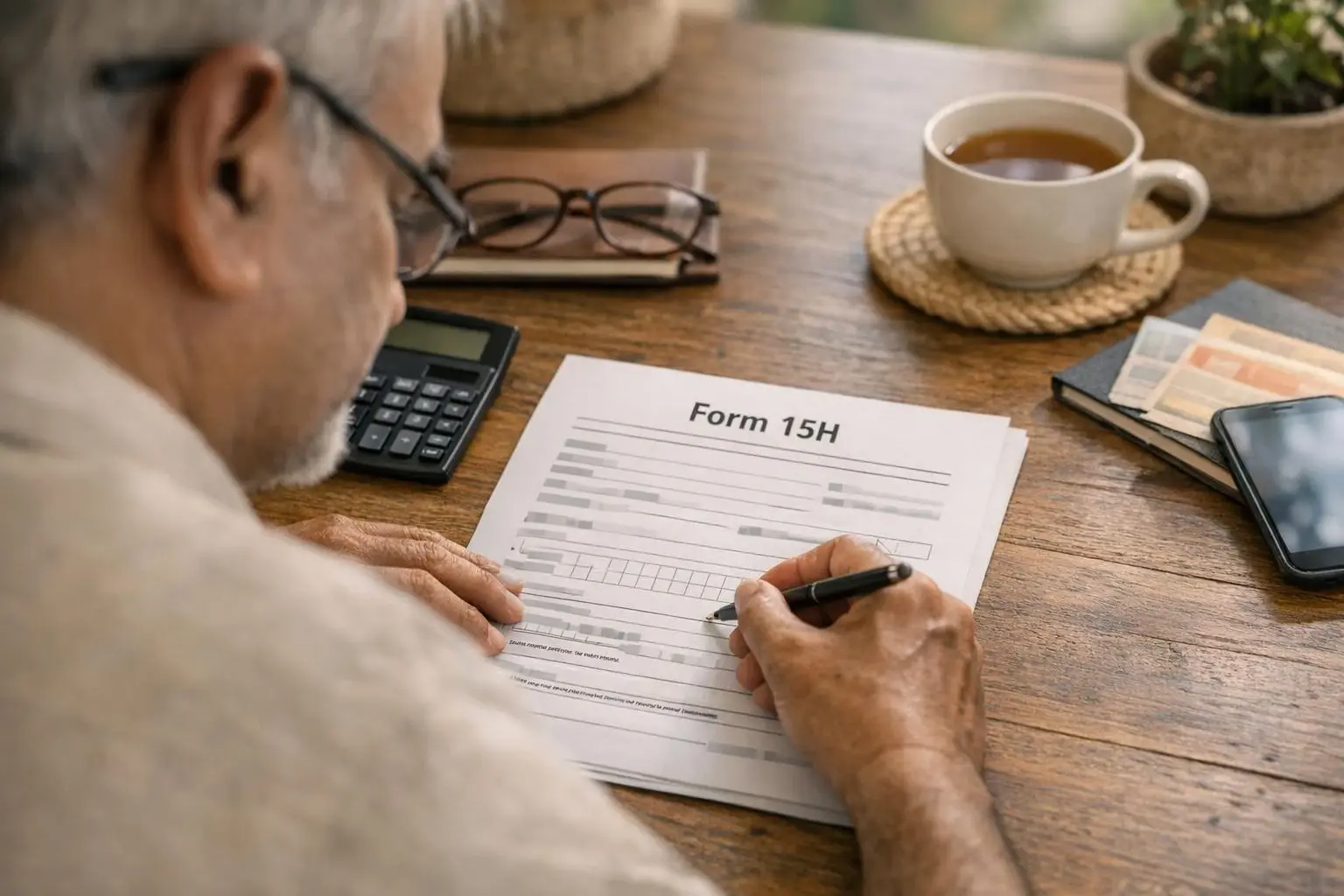
Form 15H plays a crucial role in helping senior citizens manage their cash flow effectively. Since many senior citizens depend on interest income for their daily expenses, TDS deductions can create unnecessary financial strain, especially if their total income is below the taxable limit. By submitting Form 15H, they can avoid the hassle of claiming refunds later, which can be time-consuming and delay access to their funds.
And Form 15H reduces the administrative burden on both the taxpayer and the Income Tax Department. Without it, senior citizens would need to file income tax returns to claim refunds for the TDS deducted, even if their income is tax-exempt. This form simplifies the process, ensuring that only those with taxable income pay taxes. While others receive their full interest income without deductions.
When Form 15H Matters Most?
Form 15H is particularly important in the following situations:
- When a senior citizen has multiple fixed deposits or savings accounts across different banks, as TDS may be deducted by each institution separately.
- At the start of a financial year, to ensure no TDS is deducted on interest income earned during the year.
- When the total income of the senior citizen is just below the taxable limit, making them eligible for the exemption.
- If the senior citizen does not have other sources of income that would push their total income above the taxable threshold.
It is also important to note that Form 15H is not applicable if the senior citizen’s income includes other taxable components, such as rental income, capital gains. Or business income, that push their total income above the exemption limit. In such cases, TDS deductions may still apply. And the senior citizen would need to file an income tax return to claim any refunds.