How Professional Online ITR Filing Works From Documents to Verification in India
Online ITR filing with a tax consultant in India involves submitting required documents, tax expert review, preparation of the return, filing it electronically, and completing e-verification. Chartered Accountants review the ITR before submission. The time needed depends on the case, and taxpayers receive an ITR acknowledgement and computation sheet after filing.
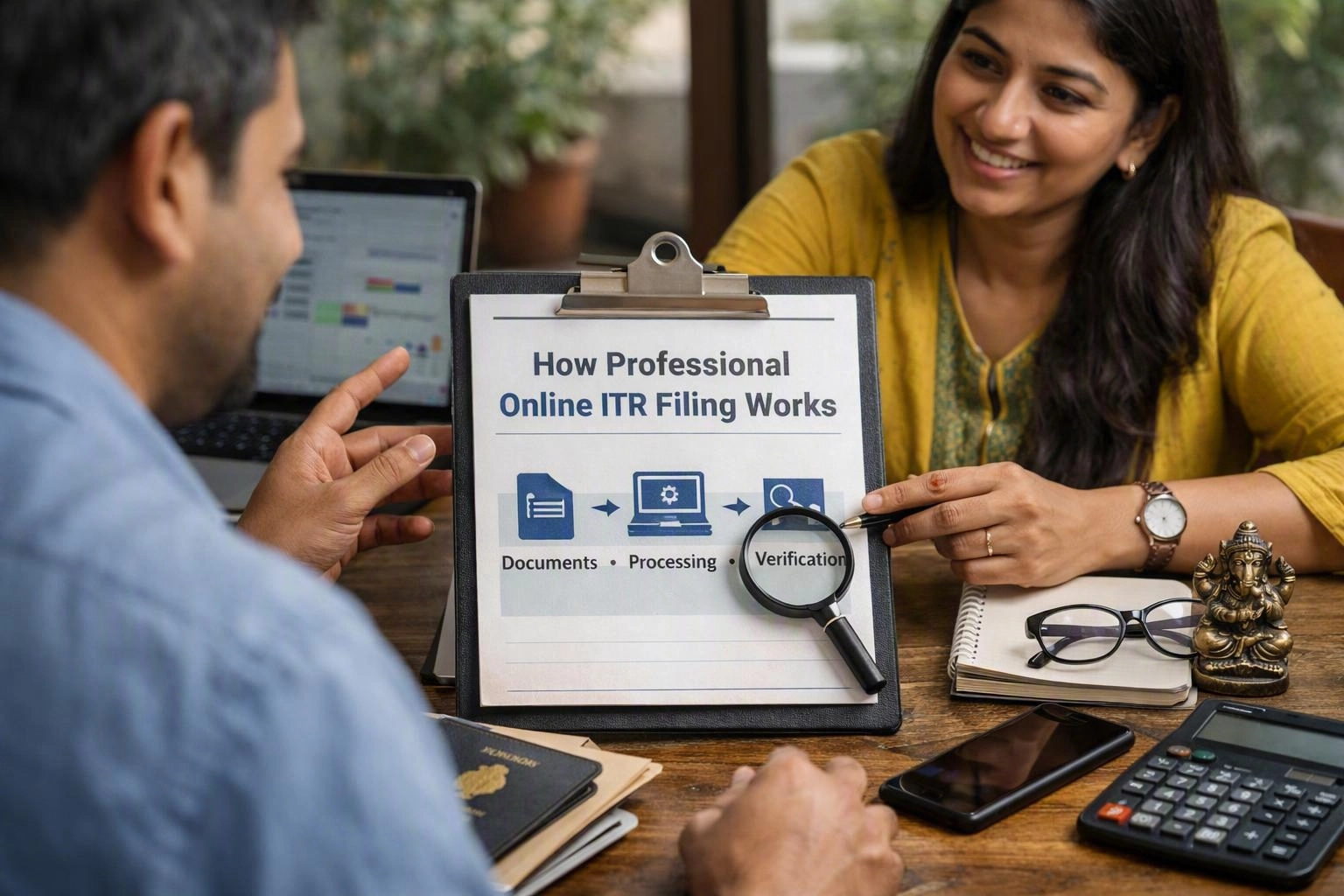
For most taxpayers, the process stays simple when each step is done in order. First, you gather records. Then the documents are checked, the return is prepared, the numbers are reviewed, the return is filed on the e-filing portal, and e-verification is completed. In India, PAN and Aadhaar linkage is a basic local requirement for many taxpayers before an Income Tax Return can be filed smoothly.
Step-by-Step Online ITR Filing Process with a Tax Consultant in India
Online ITR Filing with a tax consultant in India follows a simple process, document submission, ITR preparation, CA review, electronic filing, and e-verification completion by the taxpayer or authorised person.
This clear process helps cut errors, keep records complete, and support better tax compliance. That's why many people choose expert tax filing support. It's even more helpful when salary, capital gains, business income, rent, foreign assets, or many deductions are involved. Indian tax rules can be detailed, so many people want a careful review before filing.
If you want a simple route. Many taxpayers use Online ITR Filing Help in India because the basic sequence stays the same. Still, the level of checking changes with the case. We guide each step, so the return isn't only submitted but also reviewed and closed with verification.
Documents Required for Professional ITR Filing in India
Expert ITR filing requires documents such as PAN card, Aadhaar, Form 16, bank statements, investment proofs, and other income details essential for accurate tax return preparation.
The exact checklist depends on whether the return includes salary, business, capital gains, rent, or other income. A complete record set helps avoid mismatch notices. It also supports clean tax consultant services from start to finish.
For many taxpayers, ITR Filing gets easier when the checklist is ready before drafting starts. Our team reviews the papers early. That helps us spot missing records before the return reaches the filing stage.
Role of Chartered Accountants in Reviewing ITR Before Filing
Chartered Accountant review means the ITR is checked before filing to improve accuracy, support compliance with tax law, and help the taxpayer claim eligible benefits correctly.
A CA does more than check basic math. The review usually covers the right return form, each income head, deduction eligibility, TDS, and whether the return matches available records. These records may include Form 16, bank interest details, and tax portal data. If a person has salary plus rent, capital gains, freelance receipts, or business income, this review matters even more.
This stage also helps catch real issues. These may include duplicate income entries, missed interest, tax mismatches, or claims without proper papers. In many cases, the reviewer also checks if the old regime or new regime was applied correctly. That is why many people use Tax Return Submission support instead of filing fully on their own.
In India, this review matters because tax rules are detailed and often updated through forms, portal checks, and reporting rules. A careful pre-filing check can lower the chance of notices, refund delays, or later revision. When we handle returns, our team works to make sure the filed version is complete, clear, and ready for submission through the department system.
Typical Duration for Preparing and Filing an Income Tax Return
The time to prepare and file an ITR varies by case complexity, small cases take 1 to 2 days, average cases 3 to 5 days, and large or complex returns up to 7 days or more.
The filing timeline depends on how complete the documents are, how many income heads are involved, and whether tax payment or clarifications are needed. Most delays happen when papers come in parts. Delays also happen when reported income does not match the supporting records.
| Project Size | Typical Duration | What It Usually Includes |
|---|---|---|
| Small | 1 to 2 days | Single salary income, basic deductions, one or two bank accounts, standard documents ready |
| Average | 3 to 5 days | Salary plus interest, rent, multiple deductions, moderate review, some clarification needed |
| Large | Up to 7 days or more | Capital gains, business or professional income, foreign reporting, multiple statements, deeper review |
These are common ranges, not fixed deadlines. Turnaround is often faster when the checklist is complete and approval comes quickly. More time may be needed if revised records, challan payments, or portal validation issues appear during the work.
Who Completes E-Verification After Filing Your ITR?
E-verification is completed by the taxpayer or an authorised representative using methods like Aadhaar OTP, net banking, or bank-linked options to validate the filed return electronically.
After the return is submitted on the e-filing portal. It stays pending until verification is done within the allowed time. In most personal cases, the taxpayer completes this step directly. That's because the method is linked to personal credentials such as Aadhaar OTP, bank access, or demat-linked validation where available. If someone else is allowed to act. That person must be properly authorised under the applicable process.
This is an important local rule in India. The Income Tax Department accepts specific e-verification methods, and they are part of the formal filing process. They are not optional. If verification is missed, the return may be treated as not fully completed even after upload. That's why we remind clients to finish the final confirmation quickly and keep proof of successful electronic verification.
Receiving Your ITR Acknowledgement and Computation Sheet
ITR Acknowledgement and the computation sheet are issued after filing so the taxpayer has proof of submission and a summary of how the return figures were worked out.
Once the return is filed and verified. The system generates an acknowledgement receipt from the Income Tax Department. This is the official proof that the Income Tax Return has been submitted. People often use it for finance applications, audits, future filings, and internal bookkeeping. The acknowledgement is not the same as refund approval, but it is the first proof that filing is complete.
The computation sheet is the working summary behind the filed return. It usually shows income under different heads, deductions claimed, taxes paid, interest if any, and whether there is a refund or balance tax payable. Together, these records help the taxpayer understand the final numbers instead of only seeing the filed form on screen.
When we complete Online Tax Filing work. We make sure clients receive these post-filing documents. That helps them keep a proper file for future reference and Annual Income Tax Compliance.
Questions About ITR Filing in India
Related Resources
Benefits of Online ITR Filing Help for Freelancers and Small Businesses.
Benefits of online ITR filing help for freelancers and small business.
What It CostsBusiness and Freelancer ITR Filing, Costs, Scope, and What to Expect.
business ITR filing charges India
What It CostsITR Filing for Capital Gains and House Property Income, Fees and Service Scope.
capital gains ITR filing charges India
Compared ToCA, Online Platform, or Self-Filing, Which ITR Option Is Right for You?
CA vs online ITR filing vs self filing India