ITR Filing in Delhi for Salaried Employees vs Mumbai Freelancers
A salaried employee in Delhi usually files a simpler ITR because Form 16, standard deduction, and employer-linked TDS make income reporting easier. A freelancer in Mumbai must report business income, track invoices and expenses, and often handle more documents for deductions and advance tax. Salary is taxed under employment income rules, but freelance earnings are taxed as professional or business income, so filing effort and compliance steps are different. Choose the right ITR and file accurately to avoid notices.
ITR filing for salaried employees in Delhi and freelancers in Mumbai compares income, deductions, compliance, and filing requirements under Indian income tax rules. In metro jobs, employer TDS and Form 16 make salary return filing more standard. Project-based work usually needs invoice records, expense proof, and careful e-filing under personal taxation rules.
For a Delhi salaried employee, the process often starts with salary slips, AIS reconciliation, and a quick check of Chapter VI-A claims. For a Mumbai-based independent professional, the reporting is closer to business income return work. Receipts, client contracts, and expense logs matter more. That difference shapes taxable income, form selection, and how much review you need before submission.
Here, the comparison is not about one city being more tax-heavy than the other. It is about how income tax return rules treat employment income and freelance earnings differently. In both cases, accurate disclosure matters, But the self-employed filer usually has more moving parts and a higher chance of mismatch if records are weak.
Salaried Employee in Delhi vs Freelancer in Mumbai: What Changes in ITR Filing?
A salaried employee in Delhi files ITR mainly from Form 16 and salary slips, while a freelancer in Mumbai files ITR from invoices, expense records, and client receipts. Salary is straightforward employment income. Freelance income is business or professional income, so it needs broader reporting and expense tracking.
For a metro employee, the tax return usually reflects a fixed employer setup, monthly TDS, and a clear salary statement. The Delhi salaried employee profile often fits a standard compliance pattern. Employer withholding, known allowances, and less guesswork all help. That is why salary income is usually easier to reconcile with the AIS report and bank credits.
By contrast, a Mumbai freelancer may work with several clients, different invoice cycles, and variable payments. That makes professional income reporting more detailed. The return must reflect gross receipts, eligible expenses, and any advance tax paid during the year. If the freelancer also has mixed income, the filing becomes even more complex.
The right ITR forms also differ. Most salaried taxpayers use ITR-1 if they meet the eligibility rules. Independent earners often move to ITR-3 because the return must capture business or professional income. In both cities, the key is matching the filing method to the actual income type, not the work location alone.
In practice, Delhi and Mumbai only change the local work pattern, not the law. Metro employment usually means cleaner documentation. Self-employed work means more invoice-based proof. If your records are organized, direct tax compliance stays manageable. If not, the risk of mistakes and notices goes up.
Quick Comparison of Salary Income and Freelance Income in India
Salary income is usually easier to file because TDS is deducted by the employer and deductions are limited to documented eligible claims. Freelance income needs expense tracking, self-calculated tax, and often advance tax payments. For most taxpayers, salary filing is simpler. Freelance filing offers more deduction planning, but it also adds more compliance steps.
| Factor | Option A: Salaried income | Option B: Freelance income |
|---|---|---|
| Taxable income | Usually reported from Form 16, salary slips, and AIS matching | Reported from invoices, receipts, and net professional income after expenses |
| Deductions | Standard deduction plus eligible Chapter VI-A claims such as 80C and 80D | Business-related expenses, plus Chapter VI-A where eligible |
| Advance tax | Usually handled through employer TDS, so separate payment is less common | Often needed when TDS is insufficient or income is irregular |
| TDS | Typically deducted by the employer, reducing year-end tax pressure | May be deducted by clients, but often not enough to cover the full liability |
| Best-for | Taxpayers who want speed, simpler e-filing, and lower maintenance | Taxpayers who need deduction flexibility and can manage bookkeeping |
Pros of Filing as a Salaried Employee
Cons of Filing as a Salaried Employee
Pros of Filing as a Freelancer
Cons of Filing as a Freelancer
Which Deductions Can Salaried Employees and Freelancers Claim?
Salaried employees can claim the standard deduction and common Chapter VI-A deductions like 80C and 80D. Freelancers can usually claim business-related expenses such as internet, software, travel for work, and office costs if they are wholly and exclusively for earning income. Freelancers may have wider deductible expense categories, but they need better records.
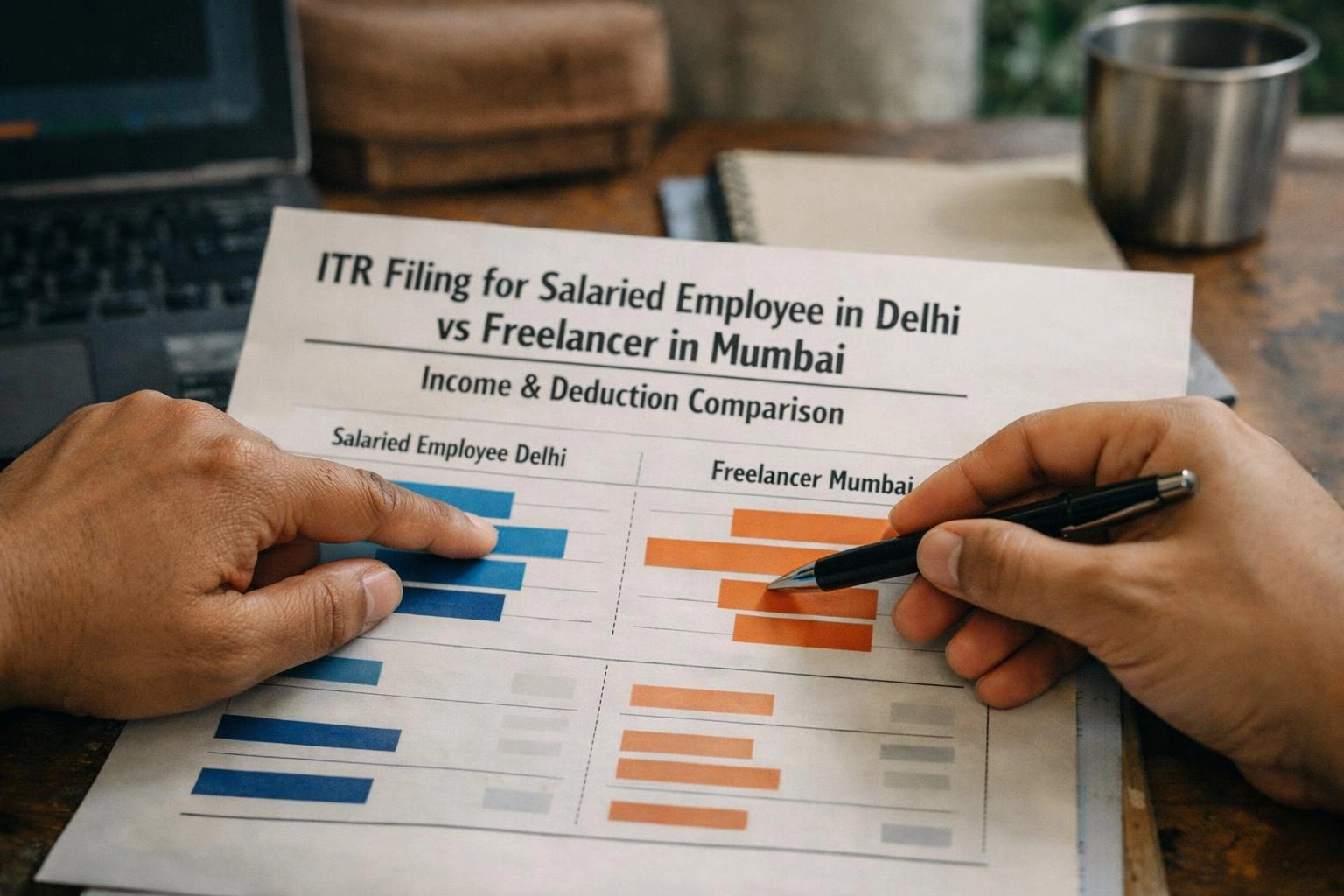
The standard deduction is a salary-specific benefit, so a salaried Delhi taxpayer often gets an automatic base deduction before tax is calculated. On top of that, eligible claims under Section 80C and Section 80D can reduce tax if the documents are in place. This keeps personal taxation predictable for employment income.
A Mumbai freelancer, however, does not claim the standard deduction for professional receipts. Instead, the return can include business expenses that are wholly and exclusively used for earning income. That may cover internet, laptop depreciation where applicable, software subscriptions, coworking space, phone use for work, travel tied to projects, and other genuine operating costs.
Because freelance income is closer to a professional income return, record quality matters more than the category names. Keep invoices, payment proofs, and usage notes ready. In India, tax officers may compare the claim against AIS, bank credits, and return history, so vague or mixed-purpose expenses are risky. This is where a self-employed filer needs stronger discipline than a salaried taxpayer.
For both groups, Chapter VI-A still matters. A salaried employee may use 80C and 80D with salary income, while a freelancer may use those deductions too if eligible. The difference is that the freelancer has two layers of planning: deduct genuine costs from receipts first, then apply eligible personal deductions afterward.
Pros and Cons of Filing as a Salaried Employee or Freelancer
A salaried taxpayer usually enjoys easier filing, while a freelancer taxpayer gets more deduction flexibility but must handle a higher compliance burden. The best choice depends on whether you prefer speed and predictability or more control over business costs and taxable income.
In Delhi metro employment, the filing path is often standardized and routine. In Mumbai project work, it is common to see mixed clients, changing cash flow, and periodic advance tax payments. That makes the freelance route more flexible, but it also demands stronger tax discipline and bookkeeping.
How to Choose the Right ITR Form and Avoid Common Mistakes?
A salaried Delhi employee commonly uses ITR-1 if eligible, while a Mumbai freelancer often needs ITR-3 because freelance receipts are treated as professional income. The biggest mistakes are selecting the wrong form, mismatching AIS data, missing advance tax, and claiming expenses without proof, So accurate classification is critical.
India-specific TDS and AIS reconciliation rules affect both salaried and freelance filers differently, which raises mismatch risk for non-salary income. That is why classification matters more than city labels. A Delhi employee with only salary may have a cleaner return. A Mumbai independent professional needs more careful form selection and expense verification.
When Should You Get Help with Income Tax Filing in India?
You should get help when your income sources are mixed, your freelance expenses are numerous, your tax is not fully covered by TDS, or you want to reduce errors in ITR selection and reporting. For complex cases, professional filing support lowers notice risk and improves accuracy.
Get CA assistance if your self-employed records are large, your AIS shows multiple entries that need reconciliation, or you are unsure whether the return should be filed as salary return filing or professional income return. A tax notice often starts with a small mismatch, so cleaner e-filing can save time later.
Support is also useful when you are moving between employment and self-employment, or when you have both salary and freelance income in the same year. In that situation, the filing becomes a direct tax compliance exercise, not just a routine online form. Good review matters more than speed.
If you want help with e-filing, form selection, or record review, you can use contact support to get guidance before filing.