Signs You Need Late or Revised ITR Filing Help in India
You need to file revised ITR in India if you find a mistake after filing. Common errors include missed income, wrong deductions, bad bank details, or the wrong ITR form. You may also need late ITR filing help if you missed the due date, got a tax notice, or need to fix TDS, capital gains, or disclosure errors. Quick action can cut interest, penalties, and compliance risk, and expert revised ITR filing support can fix the return the right way.
Revised ITR help is needed when a taxpayer in India finds filing errors, missed income, wrong deductions, or a missed return deadline. In India’s Income Tax Return (ITR) process, even a small mismatch can affect refund timing, self-assessment tax, and compliance, so early correction matters.
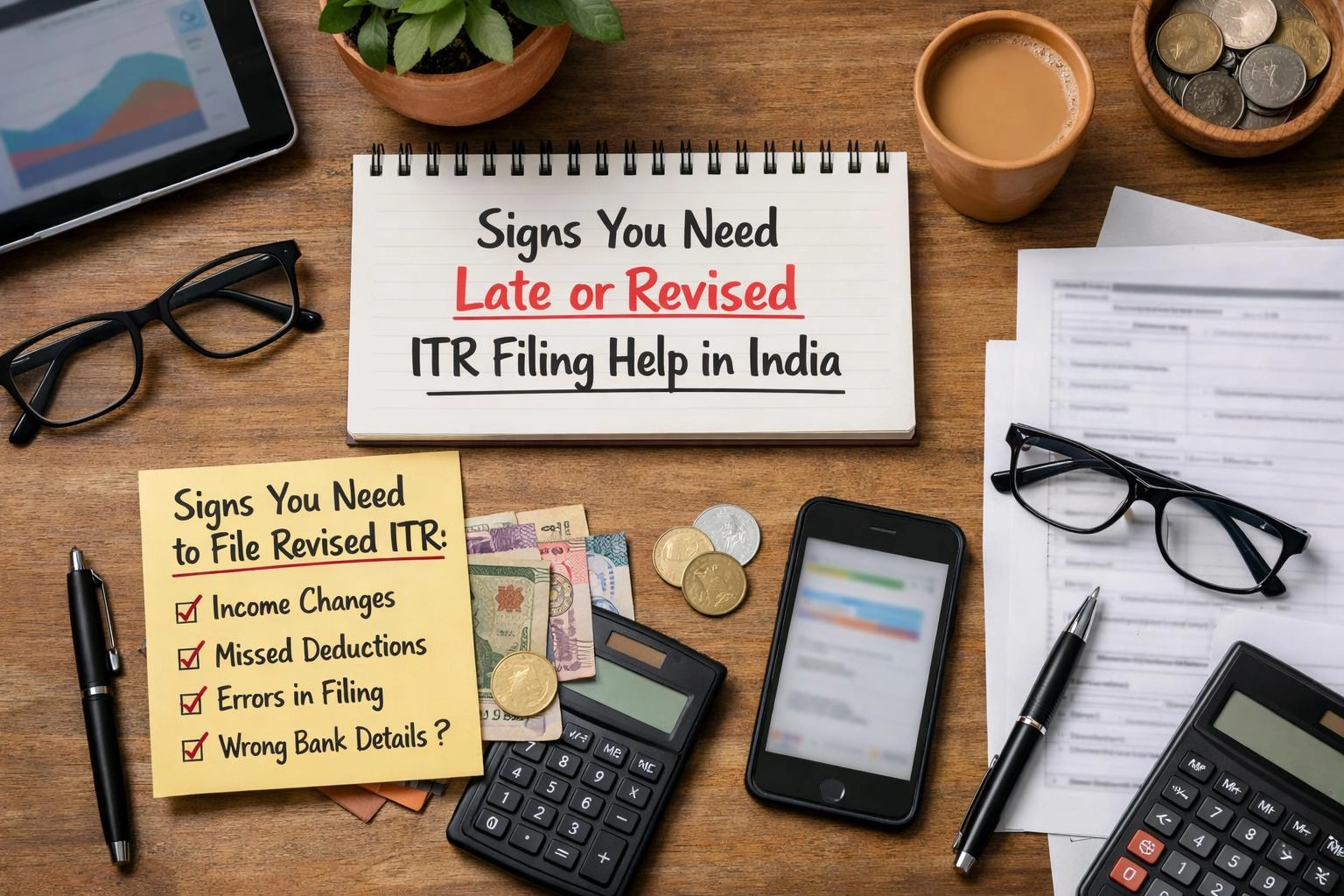
The clearest warning signs often show up after you compare your filed return with Form 16, AIS/TIS, and Form 26AS. If the income schedule, deduction schedule, or bank details don’t match the records, a return correction may be the safer path. This matters most for salary, interest, freelance income, and capital gains disclosure, where reporting gaps happen often.
Indian taxpayers often face a high revision risk because income can come from employers, banks, brokers, and mutual fund statements. A corrected ITR can help avoid refund delays, reduce tax notice risk, and keep your tax filing aligned with current checks.
- Missed income in the return. Salary arrears, savings interest, freelance receipts, rent, or other income may be left out by mistake.
- Wrong deduction claim. An excess or ineligible deduction under sections like 80C or 80D can change your tax liability.
- TDS credit mismatch. If the TDS credit shown in Form 26AS or AIS/TIS does not match the filed return, a revised return may be needed.
- Incorrect bank details. A wrong account number or IFSC can delay refunds and create extra follow-up work.
- Wrong ITR form. Filing under the wrong category can make the original return incomplete or invalid for your facts.
- Capital gains disclosure gap. Sale of shares, mutual funds, property, or other assets must be reported correctly to avoid mismatch notices.
- Notice response required. If the department sends a query after filing, you may need ITR rectification or a revised filing to match records.
- Missed deadline. If you did not file on time, a belated return may be the only available route for compliance.
The practical rule is simple: if the filed return no longer matches your records, your AIS/TIS reconciliation, or your Form 26AS, don’t ignore it. A revised income tax return is usually the best fix when the error is material and the filing window is still open.
The most common triggers for a revised return are omitted income, mismatch in TDS credits, excess or ineligible deductions, and errors in personal or bank information. These mistakes matter because the Income Tax Department compares your return with employer, bank, and AIS/TIS data, so even small mismatches can create compliance issues.
Typical filing mistakes include items that seem minor at first but create a report mismatch later. A missed dividend, an unreported savings account interest entry, or a deduction claim that doesn’t match the proof can all lead to a correction request. In India, return revision is often driven by the same data that powers AIS/TIS reconciliation and Form 26AS checks.
- Missed income: Interest, freelance earnings, rent, dividends, or capital gains may not have been entered in the original tax filing.
- Wrong TDS credit: TDS credit may appear in Form 26AS or AIS/TIS but not have been picked up correctly in the return.
- Wrong deduction claim: A deduction schedule may include a claim that is not supported, not eligible, or entered in the wrong section.
- Bank or personal data errors: Wrong PAN-linked bank details, account numbers, or IFSC codes can disrupt refunds and notices.
- Capital gains disclosure gap: A sale transaction from stocks, funds, or property may be missing or reported with the wrong cost base.
- Self-assessment tax mismatch: Tax paid but not reflected properly can create an apparent shortfall in the filed return.
When records are spread across employer statements, bank PDFs, broker reports, and portal data, a return correction becomes more important. That’s why many taxpayers ask for professional filing service support when the pattern shows several mismatches instead of one simple typo.
Late ITR filing help becomes necessary when you miss the original filing deadline, need to file a belated return, or must respond to a tax notice after not filing on time. In India, late filing can affect refunds, attract interest, and limit some loss carry-forward benefits, so timely correction is important.
A missed due date is different from a simple return correction. If you did not file by the deadline, the first question is whether a belated return is still allowed for your assessment year. If you already received a tax notice, the response may need both compliance action and careful drafting so your explanation matches the facts.
Late filing also matters when the return was never filed at all, or when the original submission was so incomplete that a revised filing is not enough. In those cases, the safest path is often to check the filing status, understand the notice response needed, and complete the correct form without delay.
DIY filing is usually enough for simple, low-risk corrections, but professional help is safer when there are multiple income sources, capital gains, foreign assets, notice replies, or repeated reconciliation mismatches. A structured service lowers the chance of filing the wrong revised return again and helps keep compliance accurate.
| Factor | DIY | Professional |
|---|---|---|
| Complexity of the error | Works for a single typo, simple bank detail fix, or one missed deduction. | Better for multiple errors, income mismatch, or full return revision after filing. |
| Reconciliation | You must compare Form 16, AIS/TIS, and Form 26AS yourself. | A reviewer handles AIS/TIS reconciliation and checks for hidden gaps. |
| Risk of repeat error | Higher if you are unsure about the correct ITR form or schedules. | Lower because the corrected filing is checked before submission. |
| Notice response support | You prepare the explanation and supporting papers alone. | Useful when a tax notice needs a clear and consistent reply. |
| Best fit | Simple return correction with clear documents. | Complex tax filing, capital gains, foreign assets, or belated return cases. |
As a general guide, DIY filing is often fine for a one-line correction, while professional filing service support is safer when the case involves income schedule changes, refund adjustment issues, or repeated mismatches across portals. In India’s compliance setup, that extra review can prevent avoidable notices and rework.
Before you revise your ITR, collect Form 16, AIS/TIS, and Form 26AS first. These records show what was reported, what was credited, and where the mismatch sits, so you can correct the return cleanly and avoid another filing error.
You should also gather bank statements, investment proofs, capital gains statements, and any tax notice or acknowledgment from the original submission. This makes it easier to compare the income shown in the original ITR with the real data, especially when salary, interest, self-assessment tax, or broker reports don’t line up.
- Form 16: Check salary, allowances, and TDS details against the filed return.
- AIS/TIS: Review the reported income, tax credits, and alerts for mismatches.
- Form 26AS: Confirm TDS, TCS, and advance tax credits before changing the return.
- Bank statements: Match interest income, refund entries, and account details.
- Capital gains statements: Use broker or mutual fund reports to verify sale transactions.
- Proof of deductions: Keep documents for the deduction claim if you are correcting an amount.
A clean document set helps you decide whether a corrected ITR is enough or whether the problem is broader. When the source data is complete, the revised income tax return is more likely to match the compliance record the first time.
ITRFiling.org.in helps taxpayers identify filing errors, correct income tax returns, and complete late or revised ITR filing in India with guided review and submission support. The service is useful when you need accurate correction, faster reconciliation, and a compliance-focused process that reduces avoidable mistakes.
In the Indian environment, the biggest advantage is structured handling of AIS/TIS, Form 26AS, and deduction schedule checks before filing. That matters because many taxpayers have salary income, interest, capital gains, and freelance receipts in the same year, and one missed line can trigger refund delay or a tax notice.
Whether the issue is a belated return, a return revision after filing, or a notice response, the process aims to reduce repeat errors and keep the filing consistent with your records. If you’re unsure whether DIY filing is enough, a professional filing service can help you choose the correct correction path with less risk.
Check your revised filing options if your return has a mismatch, missed income, or an unresolved compliance issue.
Frequently Asked Questions
Need Help Correcting Your Return?
If your filing has a mismatch, missed income, or a deadline problem, the safest next step is to review the facts and choose the right correction path. Professional support can help with return correction, belated filing, and notice follow-up without adding fresh errors.
Get a Free Estimate